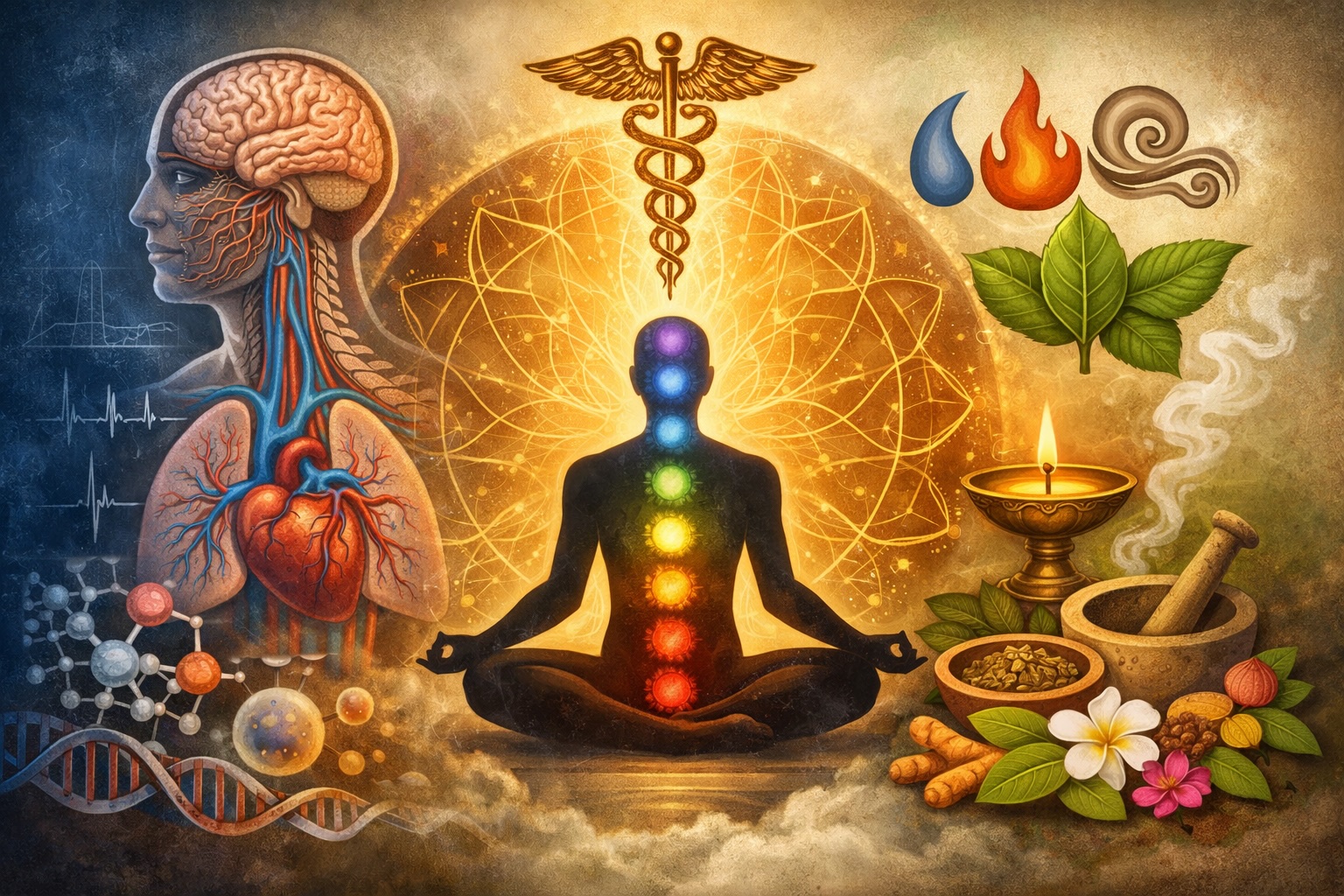
In the eyes of most people, anatomy and cadavers are inseparable. Speak to any practising doctors regarding their experiences as medical students in anatomy, and their thoughts will automatically drift to the dissecting room, the cadavers and the articulated skeleton hanging on the walls of the room.
It’s a great disappointment that the dissecting room is seen as the place where anatomy begins and ends. This is, unfortunately, a totally misleading and uncooperative piece of information. The mere opinion that the world of the anatomist is nothing more than that of dead bodies lying on the dissection tables in the dissecting room itself is a misrepresentation. The other fascinating part of anatomy i.e. study at the levels of cells or subcellular or molecular levels, is sadly nowhere to be found.
When we discuss about the anatomy of the body, all of our attention will be mainly confined to relatively large body parts (षडङ्ग), such as arms, legs, abdomen, head etc. But whenever an anatomist thinks of the body his view moves in a series of multiple levels. They instantaneously move from the overview provided by gross anatomy, then to the next level represented by the systems of the body (स्रोतस्,सिरा,धमनी), gradually to the organs (आशय, प्रत्यङ्ग), which constitute much of the systems and ultimately to the tissues (धातु) that are found within and between the organs (कला). This gradation from the largest and most apparent to the smallest and least recognisable is important descriptively, and is also an important reminder for a physician that we should never confuse these various levels.
ANATOMY AND PHYSIOLOGY is शरीर (HUMAN BODY)
Though we study human anatomy (शरीर रचन) and physiology (शरीर क्रिया) individually, the fact is that they are inseparable since function always reflects structure. That is, what a structure can do depends on its specific form. This is called the “Principle of complementarity of structure and function”. For example, blood flows in one direction through the heart because the heart has valves that prevent backflow. In Ayurveda, the nomenclature of some structures themselves reminds us of this principle. For example, the word आमाशय, meaning an organ which receivesआम(undigested) food and पक्वाशय,which receives पक्व (digested) material or the मूत्राशय, which receives मूत्र or urine. Perhaps, this is the reason why we find the term शरीर and not शरीर रचन (Anatomy) or शरीर क्रिया (Physiology) in our classics like Charaka Samhitha or Sushrutha Samhitha and others.
यत्राश्रिताःकर्मगुणाःकारणंसमवायीयत्| तत्द्रव्यं . . . . . . . . . . . . . . . . . . . . .| || च.सं.सू 1/51 ||
So, if द्रव्य(matter) isanatomy, then कर्म and गुणा are the physiology. Hence, it is practically inadequate if we don’t know both, since they are reciprocally related to each other.
FROM ELEMENT TO DEFINITE FORM
All living things are composed of matter, and they all require energy to grow and function. A matter may be solid, liquid or gaseous in state. All matter consists of small particles, and whenever these particles unite, rearrange, or break, they release energy. It is the release and consumption of energy by living systems that gives us the mysterious value called life (आयु).
Acharya Charaka has given many examples where the reference for these particles is available. Most apt quotation would be,
“शरीरावयवास्तुपरमाणुभेदेनअपरिसंख्येयाभवन्ति, अतिबहुत्वात्, अतिसौक्ष्म्यात्, अतीन्द्रियत्वात्च| तेषांसंयोगविभागेपरमाणूनांकारणंवायुःकर्मस्वभावात्च” । || चशा 7/17 ||
Here, Acharya says the human body is made up of innumerable परमाणुor particles which are incalculable, tiny and microscopic in structure. And their union or breaking down is carried out by the वायु,which is acting like a catalyst by its योगवाहिproperty.
Most of these reactions exhibit either of the following patterns: synthesis, decomposition, or exchange reactions. This illustrates the metabolism of the body. It could be anabolism, where synthesis is taking place, catabolism, where breaking down of products is happening, or both, around the clock, 24 hours a day, to keep our body alive and functioning. Even when we are asleep, our परमाणु are busy doing these activities. That is well described in our science through versus like,
चीयते अन्नादिभिः इति काय| Or , शीर्यते अनेन इति शरीर |
RELEASE AND ABSORPTION OF ENERGY
All biochemical reactions taking place inside the body represent stored energy, and all such biochemical reactions eventually result in net absorption or release of energy. Reactions that release energy are called exergonic reactions. This release of energy is used for other purposes within the body. With a few exceptions, catabolic and oxidative reactions are exergonic. अग्निtattva of our body is the one responsible for all such transformations and reactions.
In contrast, the products of energy-absorbing, or endergonic, reactions contain more potential energy. Anabolic reactions are typical energy-absorbing endergonic reactions. This is where our concept of सोम tattva can be understood.
Fundamentally, this is a case of “one hand washing the other”. The energy released when fuel (चतुर्विधआहार) is broken down is absorbed and then used to produce the intricate biological fragments the body needs to sustain life.
धारयन्तिजगद्देहंसोमसूर्यानिलस्तथा ||
साम्यत्वम् – HOMEOSTASIS
As discussed earlier, our body is made up of numerous परमाणुwhich keep on working, constantly, without rest. And when anything goes wrong with it, we then realise how well they were balanced. The internal environment of our body was kept in a dynamic state of equilibrium, in which all these structures were functioning within the narrow limits of normalcy, which we call “homeostasis”.
At first glimpse, maintaining this homeostasis is indeed complicated. Essentially, every system, every organ, every structure plays a pivotal role in maintaining this internal environment. All the systems should be functioning in such a way that the formation of nutrition, their supply and absorption by the tissues, formation of the waste materials, followed by their proper expulsion, is vital as well. Our body tries to work all the time like a stable wheel.
At this point, it is worth noting that Ayurveda has included the soul, the senses and the mind as an important part of this homeostasis, which can be considered as the definition of health and a healthy individual.
समदोषसमाग्निश्चसमधातुमलक्रिया| प्रसन्नात्मेन्द्रियमनःस्वस्थमित्यभिधीयते || सु.सू 15/41 ||
शारीरम्- स्वास्थ्यम´
By this time, it becomes much clearer that, to understand the concept of health and illness, it’s inevitable to possess a complete knowledge regarding both anatomy and physiology of the body. Since illness is nothing but an aberration in either or both of these, and treatment is nothing but stabilising and maintaining the equilibrium of them.
रोगस्तुदोषवैषम्यंदोषसाम्यमरोगता|| || अ.हृ.सू 1/20 ||
चतुर्णाभिषगादीनांशस्तानांधातुवैकृते| प्रवृत्तिःधातुसाम्यार्थंचिकित्सातदभिधीयते ||
The students of the present generation and their approach towards the study of medicine in this regard are also praiseworthy. It’s a pleasant feeling when a final year student studying surgery approaches department of anatomy to know “how the tumours are formed in the brain when the neurons doesn’t have the quality of multiplying?”, or when a second year student studying forensic medicine comes with a doubt “how the wrinkles are formed in the skin due to constant contact with the water?”.
Perhaps, this is what Acharya Charaka meant when he said, a physician “must and should” have the knowledge of the body “in all of its aspects” and “always” while treating the diseased.
शरीरंसर्वथासर्वंसर्वदावेदयोभिषक्| आयुर्वेदंसकार्त्स्येनवेदलोकसुखप्रदम् || || च.शा 6/19 ||